
Ohio USDA Home Loans: Buy a Home With Zero Down Payment
AT A GLANCE
NMLS #164070 · Ohio Licensed Mortgage Broker · Lending Since 2002
- What Is an Ohio USDA Home Loan?
- Why Does a Broker Matter for Ohio USDA Home Loans?
- Which Ohio Areas Show Up on the USDA Eligible Areas Map?
- What Income Trap Catches Most Ohio USDA Buyers?
- What Are the Credit and Debt-to-Income Requirements?
- Can USDA Finance Barns, Acreage, or Fixer-Uppers?
- What Does USDA Really Cost vs. FHA and Conventional?
- What Are the USDA Direct vs. Guaranteed Loan Differences?
- How Do You Apply for a USDA Loan in Ohio?
- Ohio USDA Home Loan FAQs
- Already Have a USDA Loan? Here Are Your Refinance Options
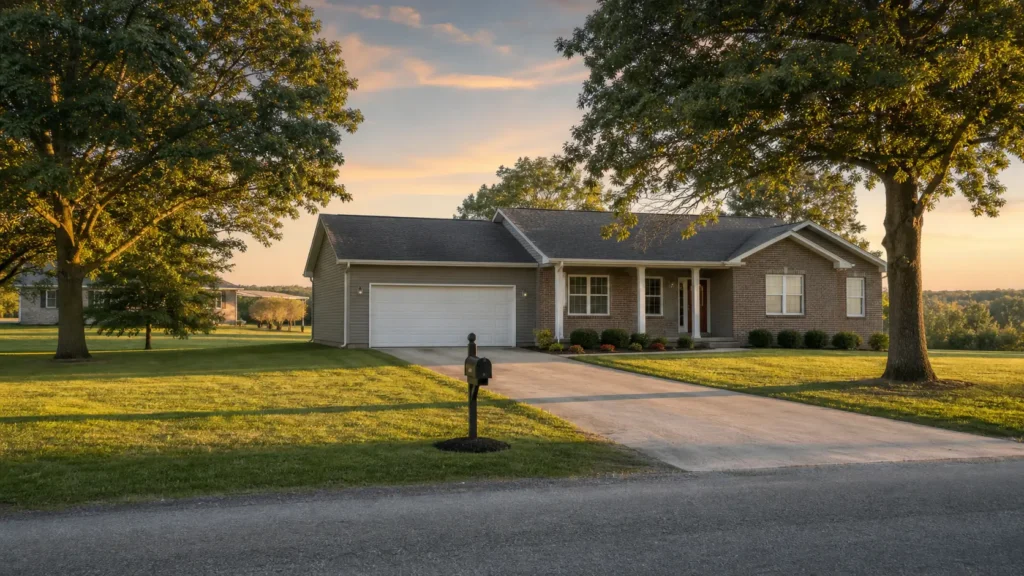
What Is an Ohio USDA Home Loan?
A USDA home loan is a government-backed mortgage that lets qualified buyers purchase a home with zero money down in eligible rural and suburban parts of Ohio. The program, officially called the Single Family Housing Guaranteed Loan Program, is built for low- to moderate-income households who don’t have 20% to put down.
If you’re buying in an eligible area, whether that’s Maineville near Cincinnati, a suburb outside Columbus, or a community near Cleveland, and your household income falls within the program’s limits, you may be able to finance 100% of the purchase price. There’s no traditional private mortgage insurance. Instead, the program charges a guarantee fee that’s lower than what FHA or conventional PMI would cost you.
The loan is a 30-year fixed rate. Period. USDA guidelines prohibit adjustable-rate mortgages, balloon payments, and prepayment penalties.
Why Does a Broker Matter for Ohio USDA Home Loans?
Because the real power of this program isn’t just zero down. It’s layering USDA with state assistance to get you into a house for almost nothing out of pocket, and that takes a lender who works both programs.
The OHFA Stacking Strategy Most Lenders Miss
The Ohio Housing Finance Agency (OHFA) offers programs that cover closing costs and down payment. Since USDA already handles the down payment at 100% financing, the real play is using OHFA assistance to cover closing costs, prepaid items, or to buy down your interest rate.
OHFA programs are available to buyers using USDA-guaranteed financing, as long as the lender is OHFA-approved and the borrower meets both USDA and OHFA income and purchase price limits. The OHFA assistance typically comes as a second lien (either forgivable or repayable, depending on the program) that fills the gap between what the seller covers and what you owe at the closing table.
What That Looks Like in Real Numbers
Closing costs on a $225,000 home in Warren County can run $6,000 to $9,000. If the seller won’t cover all of that, and the appraisal doesn’t leave room to roll it all into the loan, you still need cash. OHFA assistance bridges that gap.
When you correctly layer OHFA’s closing cost assistance over a zero-down USDA loan, the program math allows you to bring out-of-pocket cash down to nearly nothing. In markets like Maineville and Goshen, that can mean less than $500 to close on a $225,000 home. The same math works in eligible areas across Ohio, from Delaware County north of Columbus to Medina County outside Cleveland.
Why a Big Bank Can’t Do This
OHFA has its own income limits and property requirements. They don’t always line up perfectly with USDA’s. You need a lender who knows how to run both eligibility checks at the same time and structure the deal so neither program’s rules create a conflict. That’s a broker advantage: I work with multiple OHFA-approved investors who also carry USDA guaranteed loan programs. A single retail bank pushes one product. A broker shops across multiple lenders to find the combination that saves you the most cash.
Strait Talk: Most USDA content online stops at “zero down payment” and calls it a day. That’s half the story. The other half is making sure you don’t drain your savings account on closing costs. That’s what the OHFA layer does, and it’s where having a broker who’s been doing this since 2002 pays for itself.
Stop stressing over cash to close.
Let’s see if you qualify for the USDA + OHFA stack. I’ll run the federal USDA eligibility and the state OHFA qualification at the same time, so you don’t have to navigate two separate systems. One call, both answers.

Which Ohio Areas Show Up on the USDA Eligible Areas Map?
More of Ohio qualifies than most people think. The USDA eligibility map covers a huge portion of the state, including many suburbs and small towns within commuting distance of Cincinnati, Columbus, Dayton, and Cleveland.
Where the Line Falls Around Cincinnati
For buyers in Warren and Clermont counties, the news is good. Maineville sits inside USDA-eligible territory. Morrow, just up State Route 22 in Warren County, qualifies too. Goshen in Clermont County also falls within the program’s boundaries.
These aren’t remote rural outposts. They’re communities with grocery stores, good school districts, and a 30-to-40-minute drive to downtown Cincinnati. Because they currently sit outside the USDA’s ineligible urban-area boundaries, properties in these communities meet the program’s location requirement. Zero-down USDA financing still depends on the borrower, household income, property, and complete loan file meeting current USDA and lender requirements.
The Same Rules Apply Across Ohio
The Cincinnati examples above aren’t unique. Whether you’re looking in Delaware County outside Columbus, Medina County near Cleveland, or Wood County down by Toledo, the rule remains the same: once you leave the dense urban core, eligibility opens up fast.
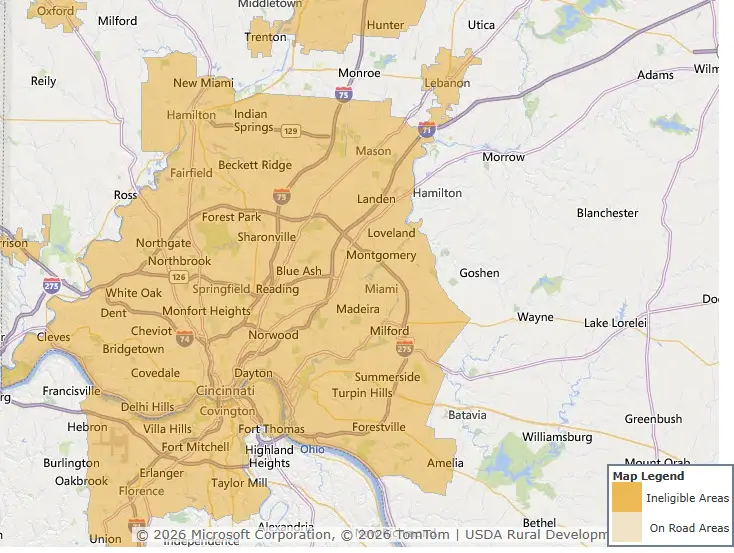
The urban cores of Cincinnati, Columbus, Cleveland, Dayton, and Toledo are excluded. But once you cross into the surrounding townships and villages, you’re likely in eligible territory. If you’re house hunting in the outer ring of any Ohio metro, check the address before you assume you’re out of bounds.
How to Check a Specific Address
Use the USDA Income & Property Eligibility Portal to check the exact street address rather than relying on a city or ZIP code. Nearby properties can fall on different sides of an eligibility boundary, so verify each address separately. The map is a preliminary check, not a final determination. USDA Rural Development makes the final property-eligibility decision after receiving a complete application.
Strait Talk: Per USDA guidelines, the property must be located in an eligible rural area as designated by the Rural Housing Service. The portal checks at the address level, not the ZIP code level. Always verify the specific property.
What Income Trap Catches Most Ohio USDA Buyers?
Your adjusted household income can’t exceed 115% of the median income for the county where you’re buying. But the word “household” is doing heavy lifting here, and it trips up more applicants than any other part of the process.
Here’s what most people get wrong: they hear “low-to-moderate income” and assume the cutoff is $40,000 or $50,000. It’s not. For a typical family of four in most Ohio metro areas, the USDA household income limit comfortably clears six figures. If your household earns $100,000 or even $110,000, you may still qualify. Don’t count yourself out before checking.
The Income Calculation Includes Every Adult in the House
USDA looks at two separate income numbers. Annual income counts every adult in the household, even people who aren’t on the loan. This determines program eligibility. Repayment income only counts the people signing the mortgage note and is used for debt-to-income ratios.
If you’re buying in Goshen and your adult child lives with you and works part-time, their wages count toward the annual income limit. They don’t need to be on the loan, but their paycheck still matters for eligibility.
Adjusted Income Deductions Most Buyers Miss
USDA allows deductions that can bring your annual income below the limit. Dependents under 18 (or full-time students under 24) generate a deduction. Childcare for kids under 12 can be subtracted. Medical expenses for elderly household members may qualify too.
If your gross household income is slightly over the line, these deductions may pull you back in. I’ve seen families in Warren County assume they were disqualified when a few deductions brought them well within range.
The “Lack of Conventional Credit” Rule
You need to show you don’t have the resources to get a conventional mortgage without the USDA guarantee. That means you can’t have a 20% down payment sitting in liquid, non-retirement accounts while still hitting acceptable debt ratios. 401(k)s and IRAs don’t count against you.
Strait Talk: Per USDA rules, households with cumulative net non-retirement family assets of $50,000 or greater must have those assets reviewed. A calculated interest rate is applied and added to the annual income number.
Citizenship and Occupancy
Applicants must be U.S. citizens, non-citizen nationals, or qualified aliens with a valid Social Security Number. You must personally occupy the home as your primary residence within 60 days of closing. And you generally can’t own another adequate dwelling at closing, though exceptions exist for job relocation, overcrowding, or medical needs.
What Are the Credit and Debt-to-Income Requirements?
Standard qualifying ratios cap at 29% for housing expenses and 41% for total debt. If your credit is strong, those caps can stretch with the right compensating factors.
Qualifying Ratio Quick Reference
| Profile | Housing Ratio | Total Debt Ratio | What You’ll Need |
|---|---|---|---|
| Standard Approval | 29% | 41% | Acceptable credit history, stable income |
| Polaris/GUS Standard | 34% | 41% | Clean automated underwriting findings |
| Strong Credit (680+) | Up to 32-34% | Up to 44% | 2+ years steady employment, 3 months PITI reserves, or minimal housing payment increase |
What Disqualifies You
A few things are automatic dealbreakers:
Any delinquent federal non-tax debt. Delinquent court-ordered child support without a documented repayment plan. An active CAIVRS claim (the federal database tracking defaulted government debts).
Bankruptcies, foreclosures, and short sales within the past 36 months are serious obstacles, though not always permanent. You’ll need documented rebuilt credit and likely a formal credit waiver.
Non-Traditional Credit Is an Option
No credit score? USDA allows alternative credit histories. A 12-month track record of on-time payments for rent, utilities, or insurance can substitute for traditional tradelines. This is a real door-opener for younger buyers or anyone who’s operated on a cash-only basis.
Can USDA Finance Barns, Acreage, or Fixer-Uppers?
Short answer: it depends on whether the property is primarily residential. The home must be “modest, decent, safe, and sanitary” (that’s the actual program language), and the site can’t be used mainly for income production or agriculture. In plain terms, this means the roof can’t be actively leaking, the foundation must be solid, and luxury features like in-ground swimming pools can sometimes cause appraisal headaches.
The Residential-Use Line
If the property has a barn, outbuildings, or acreage used for farming or income production, it may not qualify. A home on two acres with a detached garage? Probably fine. A working hobby farm with livestock structures? Different conversation. The site must be primarily residential in use, character, and design.
Manufactured Home Rules in Ohio
USDA allows manufactured homes, but only multi-wide units on permanent foundations. Single-wides don’t qualify under the guaranteed program. The home needs direct access from a paved or all-weather road and approved water and wastewater systems. Septic and well are fine, as long as they meet local health department standards.
This matters in areas like Morrow and Goshen, where you’ll find more manufactured housing stock than in closer-in suburbs. If the unit is multi-wide, permanently affixed, and meets site standards, USDA can work.
Fixer-Uppers
The property must meet minimum condition standards at closing. USDA isn’t a renovation loan. You can finance limited repairs, but the home has to be livable from day one.
Strait Talk: Per USDA guidelines, appraisals must be completed by an FHA Roster appraiser, conform to the Uniform Standards of Professional Appraisal Practice (USPAP), and meet Uniform Appraisal Dataset (UAD) requirements.
What Does USDA Really Cost vs. FHA and Conventional?
USDA is the cheapest option for buyers who qualify. Zero down, lower annual fees than FHA, and the ability to finance closing costs. The tradeoff: geographic and income restrictions that FHA and conventional don’t carry.
Slide the price bar above to see exactly how down payments, upfront fees, monthly insurance, and five-year costs compare across all three programs for your purchase price.
Why the Fee Structure Matters More Than the Rate
As the calculator above shows, USDA’s annual fee structure consistently saves you hundreds of dollars per year compared to FHA’s higher premiums, regardless of your price point. That gap adds up to thousands over the first five years of the loan.
All three programs allow seller concessions. But USDA also lets you finance closing costs into the loan if the appraised value supports it. Combined with OHFA assistance, this means you could close with almost nothing out of pocket.
What Are the USDA Direct vs. Guaranteed Loan Differences?
Two separate programs under the same USDA umbrella. Most buyers will use Guaranteed, but knowing both helps.
Guaranteed loans are issued by approved private lenders (like a mortgage broker), with USDA backing the lender against default. Income limits cap at 115% of county median income. This is the program most Ohio USDA home loan content is referring to.
I also originate FHA, VA, conventional, and DSCR loans for investors through the same wholesale channels.
Direct loans are made and serviced by USDA’s Rural Development office for very-low and low-income borrowers. These can include payment subsidies that reduce the effective interest rate. The USDA Rural Development Ohio State Office handles Direct loan applications.
For a full overview of all single-family programs, the USDA Rural Development Single Family Housing Programs page breaks down every option.
How Do You Apply for a USDA Loan in Ohio?
Applying for Ohio USDA home loans has more moving parts than a conventional purchase, but it’s manageable with the right lender guiding the timeline. Run your own numbers with my USDA loan calculator.
1. Verify Your Eligibility
Run your household income and target address through the USDA Income & Property Eligibility Portal. Confirm both your income and the area qualify before you start shopping.
2. Get Pre-Approved
I’ll pull credit, verify income and employment, review assets, and run the numbers through USDA’s automated underwriting. This also reveals whether you’re a candidate for OHFA assistance or other cost-saving moves.
3. Find the Home and Make an Offer
Work with a real estate agent who understands USDA timelines and property standards. Sellers in Maineville, Goshen, and Morrow are generally familiar with USDA offers, since a large share of the housing stock in those areas qualifies.
4. Underwriting + USDA Review
The file goes through standard underwriting, then gets submitted to the USDA Rural Development Ohio State Office for final review. Build in an extra 1-2 weeks beyond a standard conventional timeline for this step.
5. Close and Move In
Once USDA signs off, you close and take possession. You must occupy the home as your primary residence within 60 days. No exceptions.
Ohio USDA Home Loan FAQs
Already Have a USDA Loan? Here Are Your Refinance Options
Three refinance paths are available, but only for existing USDA Section 502 Direct and Guaranteed loans. You cannot refinance an FHA, VA, or conventional mortgage into USDA.
| Refinance Type | Appraisal? | Credit Check? | DTI Calculation? | Key Benefit |
|---|---|---|---|---|
| Non-Streamlined | Yes (full) | Yes | Yes | Can roll in closing costs up to new appraised value |
| Streamlined | No | Yes | Yes | Faster, cheaper when the goal is a better rate |
| Streamlined-Assist | No | No | No | Simplest path; payment must drop by at least $50/month |
If you’re sitting on a USDA loan with a rate higher than current levels, the Streamlined-Assist is the fastest path to monthly savings. No appraisal, no credit score validation, no debt ratio math.
Strait Talk: Per USDA rules, the Streamlined-Assist Refinance must provide a “net tangible benefit,” defined as a reduction of at least $50 in the monthly principal, interest, and annual fee payment.