
Ohio FHA Loans: What Most Lenders Leave Out
AT A GLANCE
- Why Do More First-Time Buyers Choose Ohio FHA Loans?
- What's the OHFA Credit Trap That Catches Most FHA Buyers?
- FHA + OHFA Underwriting at a Glance
- The 580 Line Is Where Things Get Practical
- OHFA Raises the Bar to 650
- The FHA Purchasing Power Myth (And Your Real County Limits)
- How Does FHA Mortgage Insurance Eat Into Your Payment?
- Why Do FHA Appraisals Kill Deals on Older Ohio Homes?
- How Do You Stack OHFA Assistance on Ohio FHA Loans?
- What FHA Options Do Most Ohio Buyers Miss?
- What Knocks Ohio Buyers Out of FHA Eligibility?
- How to Get FHA-Ready if You Don't Qualify Today
- Frequently Asked Questions About Ohio FHA Loans

Why Do More First-Time Buyers Choose Ohio FHA Loans?
Because the math works when other programs don’t. FHA loans are government-insured mortgages backed by the Federal Housing Administration under HUD, and that backing lets lenders offer lower down payments and more flexible credit rules than conventional financing.
I’ve been originating Ohio FHA loans since 2002, and the pattern in Warren and Clermont counties hasn’t changed: buyers with solid income but limited savings or a few credit bumps land here because no other program matches the combination of low down payment, higher allowed debt ratios, and past-hardship flexibility.
But here’s where it gets Ohio-specific. If you want to pair your FHA loan with OHFA down payment assistance, you’ll hit a higher credit floor, income caps, and purchase-price limits that vary by county. Most buyers in Mason, Maineville, Lebanon, and Loveland don’t find out about these overlays until they’re deep into the process with a lender who doesn’t handle OHFA products. That’s the gap an independent broker fills.
I work with multiple FHA lenders and know which ones pair well with OHFA layering, which ones price better for lower scores, and which ones close without dragging their feet. A big-box lender gives you their one program and hopes it fits.
Strait Talk: You don’t need to be a first-time buyer for FHA. That’s the myth I bust most often. FHA is open to repeat buyers, current homeowners looking to refinance, and people who’ve come through bankruptcy or foreclosure, as long as you meet the waiting periods and plan to live in the home.
What’s the OHFA Credit Trap That Catches Most FHA Buyers?
The federal FHA floor is lower than most people expect, but Ohio’s state-level overlays add a second hurdle that trips up buyers who only read the national sites. Here’s the full picture in one table.
FHA + OHFA Underwriting at a Glance
| Credit Score | FHA Min. Down Payment | OHFA DPA Eligible? | What to Expect |
|---|---|---|---|
| 580 or higher | 3.5% | Yes, with 650+ score | Most common path. OHFA can cover most of the down payment and closing costs. |
| 500 to 579 | 10% | No (below OHFA floor) | Manual underwrite likely. Fewer lenders will touch it. Longer timeline. |
| Below 500 | Not eligible | Not eligible | FHA requires a minimum 500. |
| No credit score | 3.5% (manual underwrite) | Case by case | Must show non-traditional credit: on-time rent, utilities, insurance. Limited lender pool. |
That table is the single most important thing on this page. Print it, screenshot it, save it.
The 580 Line Is Where Things Get Practical
Most FHA lenders I work with go down to 580 without pushback. Below that, you’re in manual underwriting territory: longer timelines, tighter documentation, and a much smaller pool of lenders willing to do the work. It’s doable, but you need a broker who knows which lenders still handle manual underwrites.
OHFA Raises the Bar to 650
If you plan to use OHFA’s homebuyer program to help with your down payment or closing costs, expect a minimum credit score around 650. That’s higher than FHA’s federal floor, and it catches a lot of buyers off guard. I walk through this with every buyer who calls from Lebanon or Mason asking about “zero down FHA,” because the answer depends on which programs you’re stacking.
Strait Talk: FHA debt-to-income limits sit at 31% front-end and 43% back-end by default. But with a 580+ score and compensating factors (cash reserves, residual income, or minimal payment shock), lenders can approve up to 40/50. Packaging the file correctly to hit those higher ratios is where having a broker who knows the guidelines makes the difference.
The FHA Purchasing Power Myth (And Your Real County Limits)
Most buyers assume the FHA loan limit will box them out of the homes they actually want. In Ohio, that assumption is almost never true. FHA sets a national floor limit for single-family homes each December, and every Ohio county sits at that floor. The cap covers most homes you’d look at in Mason, Lebanon, Loveland, or Maineville without issue. Look up your county’s current number at HUD’s mortgage limits tool.
What That Limit Means at the Closing Table
The loan limit caps the loan amount, not the purchase price. If you put 3.5% down, your actual max purchase price runs a few percent above the published limit. For most buyers shopping in Mason, Maineville, Loveland, or Lebanon, the FHA ceiling isn’t the bottleneck. Median home prices in these areas fall well within range.
The limit starts to matter if you’re targeting larger homes in the Kings or Mason school districts where prices have pushed higher. If that’s your situation, conventional or jumbo financing might be the better path.
Multi-Unit Properties Open a Different Door
Buying a duplex, triplex, or fourplex as your primary residence? FHA allows it, and the limits increase for each additional unit. Run your target property through HUD’s lookup to see where you land. I recommend this play to buyers in the Lebanon area who want to house-hack: buy a duplex with FHA, live in one unit, rent the other. The rental income can even help you qualify. Learn more about home purchase programs.
How Does FHA Mortgage Insurance Eat Into Your Payment?
Every FHA loan carries two layers of mortgage insurance. There’s no opt-out. This is the tradeoff for the lower down payment and flexible credit rules, and understanding how it hits your wallet is the difference between a smart FHA decision and a costly one.
Upfront MIP (UFMIP): 1.75% Added to Your Loan
You’ll owe 1.75% of your base loan amount at closing. On a $250,000 base loan, that’s $4,375. Almost everyone finances this into the loan balance, so it doesn’t come out of your pocket at closing. But it does increase your total loan amount and the interest you pay over time.
Annual MIP: The Monthly Line Item That Won’t Quit
Annual MIP gets baked into your monthly payment. The rate depends on your loan term, amount, and how much you put down. It adds real dollars to every payment for years.
When MIP Goes Away (And When It Doesn’t)
- 10% or more down: MIP drops off after 11 years
- Less than 10% down: MIP stays for the life of the loan
That life-of-loan MIP is why I run an FHA vs. conventional comparison for every buyer with a score above 680. At a certain score, conventional PMI is cheaper, cancels at 80% LTV, and saves tens of thousands over the loan’s life.
Use the calculator below to see exactly how MIP impacts your monthly payment, and how it compares to conventional PMI at your credit score. You can also run numbers anytime on the FHA loan calculator page.
Strait Talk: MIP isn’t a reason to avoid FHA. It’s a reason to work with someone who’ll put both options in front of you. I’ve had buyers in Maineville save $200/month going conventional, and I’ve had buyers save the same amount going FHA. It depends on your score, your down payment, and the rate you lock. The calculator above gives you a rough picture. Texting me gets you the real one.
Why Do FHA Appraisals Kill Deals on Older Ohio Homes?
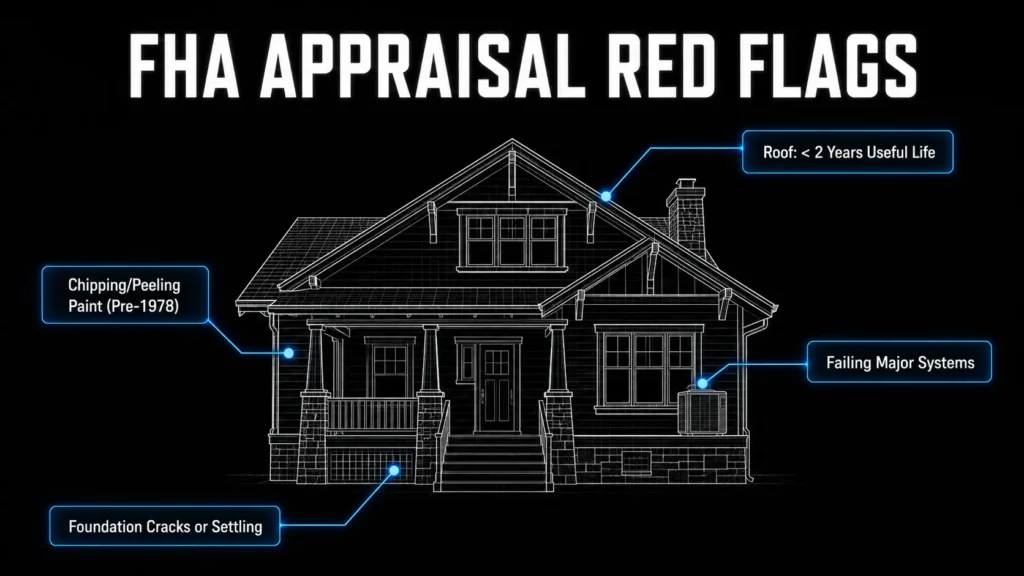
FHA appraisals check two things: market value and whether the home meets FHA’s Minimum Property Standards for safety and soundness. This double duty is where deals on older Ohio homes hit a wall if you don’t know what to watch for.
Ohio’s housing stock skews older than the national average. In Lebanon and parts of Warren County, plenty of homes were built before 1978, the cutoff year for lead-based paint rules. FHA appraisers flag any chipping or peeling paint on pre-1978 homes. It doesn’t kill the deal outright, but it means repairs before closing.
The Checklist That Trips Up Ohio Buyers
FHA appraisers check HVAC, electrical, and plumbing. Everything has to work. The roof needs at least two years of remaining useful life. The foundation can’t show major cracks or settling.
What I tell every buyer shopping older homes in Mason or Lebanon: get a home inspection BEFORE the FHA appraisal. If the inspector finds problems the appraiser will flag, you can negotiate repairs with the seller before the FHA clock starts ticking.
FEMA Flood Zone Rules for New Construction
For new construction in Special Flood Hazard Areas, the lowest floor has to sit at least two feet above the base flood elevation. For existing homes in flood zones, flood insurance is mandatory. Some areas along the Little Miami River near Maineville and Loveland fall into this category. Check FEMA flood maps before making an offer.
The 90-Day Flip Rule
FHA won’t insure a mortgage on a property being resold within 90 days of the seller’s purchase. If you’re looking at a recently renovated flip, verify the seller’s ownership timeline early.
Strait Talk: An FHA appraisal costs $300 to $600 and must be done by a HUD-approved appraiser. The appraisal stays with the property’s FHA case number, not with you. If you walk away, the next FHA buyer on that property gets the same appraisal.
How Do You Stack OHFA Assistance on Ohio FHA Loans?
You layer the Ohio Housing Finance Agency (OHFA) programs directly on top of your FHA first mortgage to reduce or wipe out your out-of-pocket costs at closing. This is the single biggest edge Ohio FHA loans have over the same program in other states, and most national lender websites skip it completely.
Step by Step: FHA + OHFA From Pre-Qual to Closing
Step 1: Qualify for FHA first. You need to meet the federal FHA requirements AND OHFA’s overlays: typically a 650+ credit score, plus income and purchase-price limits that vary by county.
Step 2: Apply through a participating lender. Not every FHA lender handles OHFA. This is where an independent broker pays for itself. I work with multiple OHFA-approved lenders and match you with the right one.
Step 3: Pick your assistance type. OHFA’s homebuyer program offers down payment and closing cost help structured as a forgivable loan or a low-interest second mortgage, depending on the program year and your eligibility.
Step 4: Close with stacked financing. Your FHA first mortgage, OHFA assistance, and any seller contributions (up to 6% of the sale price for closing costs) all come together at the closing table.
Why Local Buyers Sit in the Sweet Spot
Buyers in Mason, Maineville, Lebanon, and Loveland hit the overlap between affordable home prices and OHFA eligibility. Home prices in these communities generally fall within OHFA purchase-price limits, and median household incomes often still qualify under OHFA’s county-level income caps.
Ohio Heroes, Grants for Grads, and the Mortgage Tax Credit
Ohio Heroes provides discounted rates and DPA for military, police, fire, teachers, and healthcare workers. Grants for Grads targets recent college graduates buying their first home. The Mortgage Tax Credit is a federal tax credit that directly reduces your tax bill, potentially adding hundreds per year to your take-home pay. I can tell you which of these stack with FHA and which require conventional.
Strait Talk: I’ve closed FHA loans in Maineville where the buyer brought less than $1,000 to the closing table by stacking OHFA assistance with seller concessions. That’s not a gimmick. That’s knowing how to layer the programs. Your big-box lender’s website won’t walk you through this because most of their loan officers don’t touch OHFA.
What FHA Options Do Most Ohio Buyers Miss?
Most buyers only know about the standard FHA purchase loan. They miss the renovation program, the streamline refinance, and the specialty discounts that could save them thousands or open doors they didn’t know existed.
FHA 203(b): The Standard Purchase Loan
The workhorse. If you’re buying a primary residence in move-in condition, this is your program. Covers single-family homes, townhouses, FHA-approved condos, and manufactured homes built after June 15, 1976 (on a permanent foundation).
FHA 203(k): Buy and Renovate in One Loan
Found a fixer-upper in Lebanon’s older neighborhoods? The 203(k) rolls the purchase price and renovation costs into a single FHA mortgage.
- Standard 203(k): Major structural work exceeding $5,000. Requires a HUD consultant.
- Limited 203(k): Cosmetic and non-structural repairs up to HUD’s current cap (text me for the current number; it adjusts periodically).
Strong option for Ohio’s older housing stock, but it adds complexity. Contractor bids need to be locked before closing, and the renovation timeline is strictly managed.
FHA Streamline Refinance
Already have an FHA loan? The Streamline Refinance drops your rate with minimal paperwork. No appraisal, no income verification, and closings can happen in weeks. You need at least six months of on-time payments to qualify.
FHA Cash-Out Refinance
Tapping equity in your current home? Refinance up to FHA limits and take cash out, subject to FHA’s equity and qualification rules. See all refinance options.
Specialty Programs Worth Knowing
Energy Efficient Mortgage (EEM) finances energy upgrades (insulation, windows, HVAC) into your FHA loan. Good Neighbor Next Door offers a 50% discount on HUD-listed homes in revitalization areas for teachers, law enforcement, firefighters, and EMTs.
I handle every product listed here, plus VA, USDA, conventional, DSCR, and jumbo loans. If FHA isn’t the best fit after I run your numbers, I’ll tell you. See all loan programs.
What Knocks Ohio Buyers Out of FHA Eligibility?
A few things stop an FHA loan cold. Knowing them before you apply saves weeks of wasted effort and protects your credit from unnecessary hard pulls.
Delinquent Federal Debt
Owe back taxes to the IRS or carry unpaid federal debt (including defaulted student loans or judgments)? You’re out until you resolve the balance or get on a valid repayment plan with documented on-time payments. No exceptions.
Recent Bankruptcy
Chapter 7: Two-year waiting period from discharge. With documented extenuating circumstances (sudden job loss, serious medical event), some lenders work with 12 months.
Chapter 13: At least 12 months of the court-ordered payout period completed, with court approval to take on new mortgage debt.
Foreclosure, Short Sale, or Deed-in-Lieu
Three-year waiting period from completion, unless you can document extenuating circumstances beyond your control.
The Property Can Disqualify You Too
FHA won’t finance investment properties, vacation homes, or any home that fails Minimum Property Standards. The home must be your primary residence. You must move in within 60 days of closing and intend to live there for at least one year.
Strait Talk: “Extenuating circumstances” has a specific FHA definition: events beyond the borrower’s control that caused a sudden, significant financial impact. A divorce alone doesn’t usually qualify. A job loss due to a plant closure might. I help buyers document these properly because how you present the case matters as much as the facts.
How to Get FHA-Ready if You Don’t Qualify Today
If your credit needs work before you’re ready, a HUD-approved housing counselor can help you build a plan. In Ohio, agencies like Homes on the Hill offer free or low-cost credit readiness counseling, budgeting help, and homebuyer education.
I send buyers to counselors regularly because a few months of targeted credit work can drop your MIP rate, lower your required down payment, or open up OHFA programs you wouldn’t otherwise hit. It’s one of the highest-return moves a buyer can make. If you’d rather skip the counselor and talk numbers directly, that works too. I’ll tell you where you stand and what it takes to get where you want to go. Start with a pre-approval conversation.