
Ohio VA IRRRL: Secure a Lower Interest Rate with a VA Streamline Refinance
- What is a VA IRRRL and how does it work in Ohio?
- VA IRRRL vs VA Cash-Out Refinance: Which Program Do You Need?
- Who is eligible for an Ohio VA IRRRL?
- What are the VA IRRRL loan seasoning requirements?
- What is the net tangible benefit test for a VA IRRRL?
- How does the 36-month fee recoupment rule work?
- What are typical VA IRRRL closing costs in Ohio?
- Can you take cash out with a VA IRRRL?
- What paperwork is required for an Ohio VA IRRRL?
- How does refinancing an ARM to a fixed rate work with a VA IRRRL?
- What are the benefits of working with a local Ohio VA specialist?
- When does a VA IRRRL not make sense?
- Big Bank vs T.C. Strait: Why Local Ohio Expertise Matters
- Get a Strait-Forward Answer from T.C.
- FAQ: Ohio VA IRRRL
What is a VA IRRRL and how does it work in Ohio?
A VA Interest Rate Reduction Refinance Loan (IRRRL) is a streamlined refinance program that allows eligible veterans to replace an existing VA-backed mortgage with a new VA loan, typically to reduce the interest rate or switch from an adjustable-rate mortgage to a fixed-rate mortgage, with minimal documentation and no appraisal requirement in most cases.
Here’s how it works when you’re working with me directly instead of a national call center. You bought a home in Mason three years ago with a VA loan at 6.25%. Rates have dropped. You want to refinance to 5.50%. I pull your VA eligibility automatically. You sign a form saying you used to live there. I run the fee recoupment math to make sure your closing costs get paid back within 36 months through your monthly savings. That’s it.
I’ve had veterans in West Chester close an IRRRL in 18 days because we didn’t waste time on documents the VA doesn’t require.
Strait Talk: Per VA Circular 26-20-24, the IRRRL is strictly for refinancing an existing VA-backed mortgage. If the current loan is Conventional, FHA, or USDA, it does not qualify for the streamline program and must be processed as a standard VA refinance.
Run your numbers: Text your current loan balance and rate to 513-562-7926. I’ll tell you in five minutes if an IRRRL saves you money.
VA IRRRL vs VA Cash-Out Refinance: Which Program Do You Need?
| Feature | VA IRRRL | VA Cash-Out Refi |
|---|---|---|
| Appraisal required | No (VA doesn’t require) | Yes, always required |
| Income docs required | No (unless payment up 20%+) | Yes, always required |
| Credit check required | No (unless payment up 20%+) | Yes, always required |
| Max LTV | No limit (can exceed 100%) | 90% max (some lenders 100%) |
| Purpose | Lower rate or stabilize payment | Lower rate + pull equity |
| VA IRRRL funding fee | 0.50% of loan amount | 2.15% (first) or 3.3% (subsequent) |
| Timeline | 3-4 weeks | 6-8 weeks |
| Cash at closing | No (except energy improvements) | Yes, up to equity limit |
Use IRRRL when: You want to lower your rate or switch ARM to fixed, you don’t need cash out, and you want the simplest, fastest process.
Use cash-out when: You need equity for home improvement, debt consolidation, or major expense, or you’re refinancing a non-VA loan into VA.
Mason example: Veteran has $250,000 VA loan at 6.00%. Home worth $400,000, so $150,000 equity. Just wants to lower rate to 5.25%? Use IRRRL. Takes three weeks, no tax returns or paystubs. Wants to pull out $50,000 to remodel kitchen? Needs cash-out refi. Takes six to eight weeks, full documentation.
Funding fee difference: On a $300,000 loan, IRRRL charges $1,500 (0.50%). Cash-out charges $6,450 (2.15%) or $9,900 (3.3%). Huge difference.

Who is eligible for an Ohio VA IRRRL?
Veterans are eligible for a VA IRRRL if they have an existing VA-guaranteed loan on a property they previously occupied as their primary residence, they still own the property, and the loan has been seasoned with at least 210 days passing since the first payment due date and six consecutive monthly payments made.
Practical example: You bought a home in Maineville with a VA purchase loan in 2021. You lived there for two years. Then you got reassigned to Wright-Patterson Air Force Base in Dayton and decided to rent the Maineville house instead of selling it. You can still refinance that loan with an IRRRL. That’s different from a VA purchase loan, where you must certify you’re moving in as your primary residence.
Checklist – You Qualify If:
- You have an existing VA-guaranteed loan
- You still own the property
- You previously lived in the property as your primary residence
- At least 210 days have passed since your first payment due date
- You’ve made six consecutive monthly payments
Same borrowers, with exceptions. If you and your spouse bought together and both signed the VA loan, both of you need to be on the IRRRL. The VA allows exceptions for divorce or death. Divorced and your ex is off the title? You can refinance solo. Spouse passed away? Same thing.
Strait Talk: The VA does not mandate a new appraisal for an IRRRL because the property’s eligibility was established with the original loan. When a lender requires an appraisal anyway, it is typically an internal “overlay” designed to reduce the bank’s investment risk rather than a requirement of the VA program.
Check your eligibility: Text “QUALIFY” to 513-562-7926. I’ll ask you three questions and tell you if you’re eligible.
What are the VA IRRRL loan seasoning requirements?
VA IRRRL seasoning requirements dictate that a veteran must wait at least 210 days from their first mortgage payment due date and have made six consecutive monthly payments before closing a VA streamline refinance in Ohio, with the clock resetting to the modification date if the existing loan has been modified.
The Loan Seasoning Rule (Most Lenders Get This Wrong):
| Requirement | What It Means |
|---|---|
| 210 days from first payment | If you closed March 1, 2024 with first payment May 1, you can’t refinance until late November 2024 |
| Six consecutive payments | October 2024 payment = sixth payment, earliest you can close is November |
| Loan modifications reset the clock | If you modified your loan, seasoning resets from the modification date |
Quick check: Closed on a VA purchase loan in Mason on March 1, 2024. First payment due May 1, 2024. To refinance with an IRRRL, you’d need to wait until six payments have been made (through October 2024) and 210 days have passed from May 1 (late November 2024). Once both conditions are met, you’re clear.
Strait Talk: Seasoning requirements are a consumer protection measure designed to prevent “churning,” which is the practice of repeatedly refinancing a loan just to generate lender fees. The 210-day waiting period ensures a stable payment history is established before a new loan can be issued.
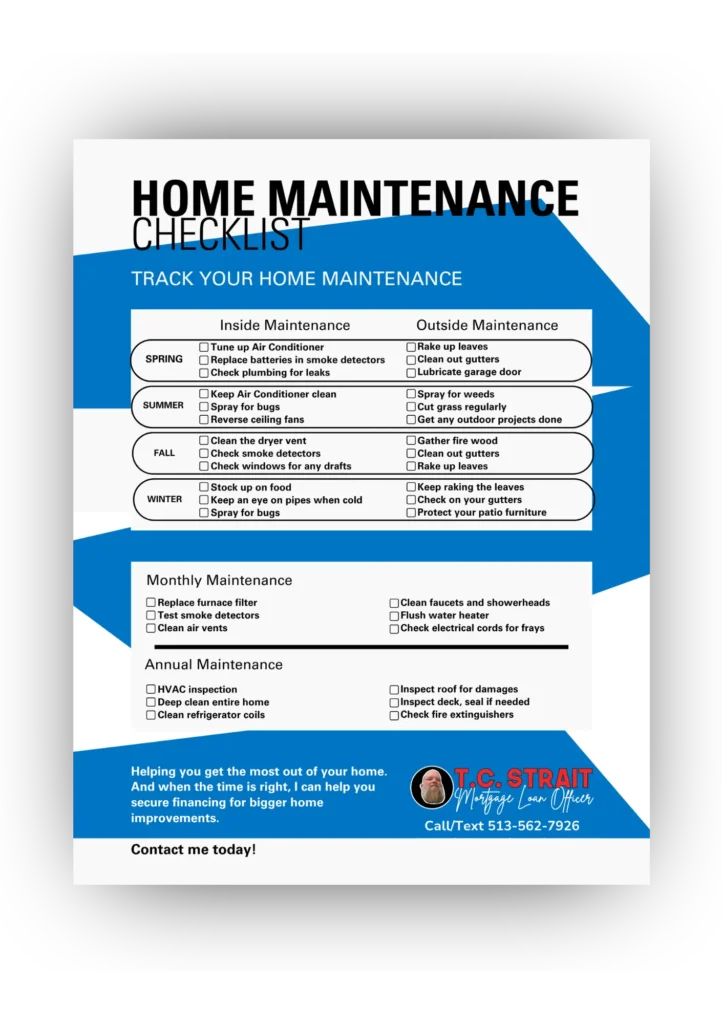
Protect Your Home Value
Consistent maintenance supports your equity and simplifies future appraisals. Use this Ohio-specific checklist to stay ahead of seasonal repairs.
What is the net tangible benefit test for a VA IRRRL?
The net tangible benefit test is a VA requirement that ensures an IRRRL provides a clear financial advantage to the borrower, with specific minimum interest rate reductions required based on the type of loan being refinanced: fixed-to-fixed requires at least 0.50% rate drop, fixed-to-ARM requires at least 2.00% rate drop, and ARM-to-fixed requires no rate reduction because stability itself is considered the benefit.
Net Tangible Benefit VA IRRRL Rules
The Rules:
| Current Loan Type | New Loan Type | Minimum Rate Drop Required |
|---|---|---|
| Fixed-rate | Fixed-rate | 0.50% (50 basis points) |
| Fixed-rate | ARM | 2.00% (200 basis points) |
| ARM | Fixed-rate | No rate drop required (stability is the benefit) |
Fixed to fixed: You’re at 6.00% now. New rate must be 5.50% or lower.
Fixed to ARM: You’re at 6.00% and switching to an ARM. New rate must be 4.00% or lower. The VA sets this higher bar because ARMs carry risk. Your rate can adjust upward, so the VA wants a big initial drop.
ARM to fixed: You have a 5/1 ARM at 5.50% and you’re worried rates will spike when your adjustment hits. You can refinance into a fixed-rate loan at 5.75%. The VA considers that a net tangible benefit because you’re trading uncertainty for predictability.
VA IRRRL Payment Increase Reasons
If you’re refinancing from an ARM to a fixed rate, your payment might increase slightly. This can happen because fixed rates are typically higher than ARM teaser rates, or because you’re extending the loan term, or because escrow amounts have changed. As long as the payment increase is less than 20%, you don’t need full income verification. If the increase is 20% or more, I’ll need to verify your income and run a full credit check.
The Discount Points Trap: If you’re refinancing from fixed to ARM and you want to buy discount points to lower the rate, those points can only be included if market conditions (not just the points) account for some of the rate drop. If the only reason your rate is 2.00% lower is because you paid three points, the VA won’t approve it.
Exceptions: LTV is 100% or less (max one financed point) or 90% or less (more than one financed point).
I work with a lot of Cincinnati and Dayton veterans who want to move from an ARM to a fixed rate because they’re tired of the uncertainty. Even if your rate goes up slightly when you lock into a fixed rate, the VA still considers it a benefit as long as you’re moving from an ARM.
How does the 36-month fee recoupment rule work?
The VA’s 36-month fee recoupment rule is a legal protection that requires all closing costs (excluding taxes, escrow deposits, prepaid expenses, and the VA funding fee) to be fully recovered through the borrower’s monthly principal and interest payment savings within 36 months of the loan closing date, calculated by dividing total allowable fees by the monthly payment reduction.
This isn’t a guideline. This is a VA-mandated legal protection. If your lender quotes fees that don’t meet this test, the VA won’t guarantee the loan.
The Math:
- Add up all fees and closing costs
- Divide by your monthly P&I savings
- Result must be 36 months or less
Real Scenario:
| Item | Amount |
|---|---|
| Current P&I payment | $2,000 |
| New P&I payment | $1,850 |
| Monthly savings | $150 |
| Total fees & costs | $4,500 |
| Recoupment period | $4,500 ÷ $150 = 30 months ✓ |
Scenario That Fails:
| Item | Amount |
|---|---|
| Monthly savings | $150 |
| Total fees & costs | $6,000 |
| Recoupment period | $6,000 ÷ $150 = 40 months ✗ |
If your recoupment is over 36 months, we have to come up with a different plan.
What’s excluded from recoupment?
- Taxes
- Escrow deposits (insurance, property taxes)
- Prepaid expenses (insurance, HOA fees)
- VA funding fee
The funding fee can be $1,500 to $2,000+, but the VA doesn’t count it against recoupment because it’s a program cost, not a lender fee.
West Chester example I ran last month: Veteran refinancing $250,000. My lender fees: $3,200. Title: $900. Credit report: $150. New payment: $1,800 instead of $1,950. Savings: $150/month.
Recoupment: ($3,200 + $900 + $150) ÷ $150 = 28.3 months ✓
If your payment increases or stays the same: You can’t have any fees or closing costs at all, other than taxes, escrow, and the funding fee. If your payment goes up, the VA assumes you’re not getting a financial benefit, so they won’t let me charge you.
Strait Talk: The 36-month recoupment rule is a legal safeguard that prevents veterans from paying closing costs that take too long to recover through monthly savings. If the math shows that the fees won’t be “earned back” within three years of lower payments, the refinance is legally considered to lack a sufficient benefit.
Does your recoupment pass? Text your estimated fees and monthly savings to 513-562-7926. I’ll run the math and tell you if it works.
What are typical VA IRRRL closing costs in Ohio?
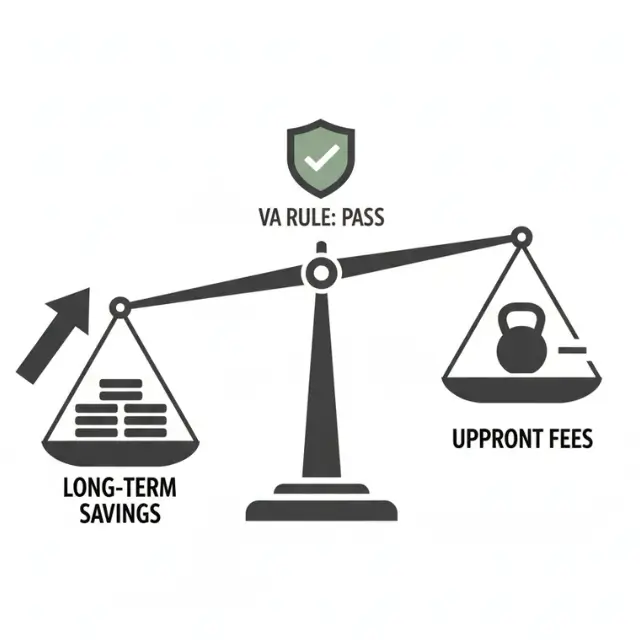
Typical VA IRRRL closing costs in Ohio range from $2,500 to $4,500 and include lender origination fees, title insurance, recording fees, credit report charges, and a VA funding fee of 0.50% of the loan amount, with all costs eligible to be rolled into the new loan balance or paid at closing.
Because I’m an Ohio-based broker serving veterans at Wright-Patterson Air Force Base and throughout Hamilton, Warren, Butler, Greene, and Montgomery Counties, my fee estimates are localized and precise. I don’t use “national averages” that leave you with a surprise bill at closing. The math I show you is the math you’ll see at the finish line.
The Breakdown:
| Cost Category | Ohio Range | Notes |
|---|---|---|
| My lender fees | $50 – $500 | Origination, underwriting, processing |
| Title & escrow | $800 – $1,200 | Consistent across Ohio counties |
| Recording fees | $195 – $275 | Minimal variation across Ohio |
| Credit report | $100 – $150 | Even if not used for underwriting |
| Appraisal | $0 | VA doesn’t require, some lenders do |
| VA funding fee | 0.50% of loan | $1,250 on $250k loan, $2,000 on $400k |
Disability exemption saves you thousands: If you’re receiving VA disability compensation for a service-connected disability, or if you’re a surviving spouse of a veteran who died in service, you’re exempt from the funding fee. On a $300,000 loan, that’s $1,500 you don’t pay.
Real Mason example: Veteran refinancing $300,000. My lender fees: $1,800. Title/escrow: $1,000. Recording: $75. Credit: $75. No appraisal. VA funding fee: $1,500. Total: $4,450.
If the payment drops by $200/month, recoupment is $4,450 ÷ $200 = 22.25 months ✓
You can pay out of pocket or finance the costs. Most veterans finance because it keeps cash free. If you finance, your new loan balance will be higher than your old balance, but your monthly payment should still drop if the rate reduction is big enough. f you have a non-VA loan and are looking for a similar low-doc option, you might consider an FHA Streamline Refinance to see if it fits your needs.
Strait Talk: A “no-cost” refinance does not eliminate closing costs; it simply finances them through a higher interest rate. This trade-off preserves immediate cash but results in a higher total interest expense over the life of the mortgage.
Can you take cash out with a VA IRRRL?
The VA IRRRL program does not allow veterans to take significant cash out at closing, as it is designed exclusively for rate-and-term refinancing, with only two limited exceptions: up to $6,000 for energy efficiency improvements completed within 90 days, and minor computational errors or fee refunds typically capped at $500.
The VA allows two tiny exceptions:
1. Energy efficiency improvements: If you completed VA-approved upgrades within the last 90 days (HVAC, insulation, solar), you can add up to $6,000 to the loan. You’ll need receipts. The $6,000 is excluded from fee recoupment, which makes it easier to meet the 36-month test.
2. Minor computational errors or refunds: Rounding errors or refunds of upfront fees (like an appraisal). Usually capped at $500.
Outside those two scenarios, you’re not getting cash. If you’re sitting on $100,000 in equity and you want $50,000 for a home addition or to pay off credit cards, you need a VA cash-out refinance. Takes longer. Requires full underwriting, appraisal, income docs.
Strait Talk: VA Pamphlet 26-7, Chapter 6, explicitly prohibits taking equity out of a home through the IRRRL program. The only exceptions are very small amounts for documented energy-efficient home improvements or minor rounding errors at the closing table.
What paperwork is required for an Ohio VA IRRRL?
VA IRRRL documentation requirements are minimal compared to standard refinances, typically requiring only a certificate of eligibility automatically pulled from the VA system, an occupancy certification signed by the borrower confirming prior residence, and a comparison statement showing the old loan versus the new loan with recoupment calculations, with full income and credit documentation only required if the monthly payment increases by 20% or more.
What I provide automatically:
- Certificate of Eligibility (I pull this from the VA system)
- Comparison statement (shows old vs new loan, recoupment period)
What you sign:
- Occupancy certification (you previously lived there)
When you’ll need more docs:
- Payment increasing by 20%+ → paystubs, W-2s, tax returns, full credit check
- Current loan 30+ days past due → letter of explanation, proof delinquency is resolved
What you probably won’t need: Tax returns (unless payment up 20%+), paystubs, bank statements, verification of employment, gift letters.
How does refinancing an ARM to a fixed rate work with a VA IRRRL?
Refinancing from an adjustable-rate mortgage to a fixed-rate loan with a VA IRRRL requires no minimum interest rate reduction, as the VA considers the stability and predictability of a fixed payment to be a net tangible benefit regardless of whether the interest rate increases, with full income documentation only required if the payment increases by 20% or more.
Example: You bought in West Chester three years ago with a 5/1 ARM at 4.50%. Your initial fixed period is ending. Your rate could jump to 6.00%+ based on current market conditions. You refinance into a 30-year fixed at 5.25%. Even though your rate is going up by 0.75%, the VA considers this a net tangible benefit because you’re locking in a predictable payment for life.
Your monthly payment might go up slightly, but as long as the increase is less than 20%, you don’t need full underwriting. If the increase is 20%+, I’ll need to verify your income and run a credit check to make sure you can afford the new payment.
Flip side: Refinancing from fixed to ARM requires your new rate to be at least 2.00% lower. The VA sets this higher bar because ARMs carry risk.
I don’t see many Ohio veterans refinancing from fixed to ARM right now because rates have been volatile. Most ARMs I’m seeing are veterans who bought during 2020-2022 when ARMs had super low teaser rates, and now they want to lock in before their adjustment hits.
What are the benefits of working with a local Ohio VA specialist?
Working with a local Ohio VA loan specialist provides veterans with precise state-specific closing cost estimates, direct access to an experienced loan officer rather than rotating call center representatives, and deep knowledge of military-specific scenarios including Wright-Patterson Air Force Base assignments and Ohio National Guard deployments.
Ohio has no state mortgage recording tax. That saves you money compared to states like Florida or New York. Recording fees are consistent across Ohio counties, and title insurance costs are competitive compared to high-cost states like California or New York.
If you’re in Mason, West Chester, or Maineville: Property values have climbed since you bought. That doesn’t affect your IRRRL (no appraisal required), but it does give you options. If you’ve built substantial equity, you might consider a VA cash-out refinance if you need access to that equity.
Wright-Patterson AFB veterans: If you’re stationed at Wright-Patt and you bought a home in Beavercreek, Fairborn, or Xenia with a VA loan, you can still refinance with an IRRRL even if you’re later reassigned and turn the home into a rental. The occupancy requirement for IRRRLs is looser than for purchase loans.
Guard and Reserve: The IRRRL works the same way for you as it does for active-duty or retired veterans. You don’t need to be on active duty to qualify.

When does a VA IRRRL not make sense?
A VA IRRRL may not be financially beneficial if the veteran plans to sell the property within two to three years before reaching the breakeven point, if the current interest rate is already at historic lows with insufficient room for meaningful reduction, or if the borrower’s credit has significantly deteriorated and the payment increase exceeds 20% requiring full underwriting.
Selling in the next two to three years? Don’t refinance. The breakeven point (time it takes for monthly savings to offset closing costs) is usually 18 to 30 months. If you sell before breakeven, you paid closing costs for nothing.
Example: Refinancing $300,000 in West Chester. Closing costs: $4,000. New payment is $150 lower. Breakeven: $4,000 ÷ $150 = 26.7 months. If you sell in month 20, you’ve only saved $3,000 ($150 x 20) but you paid $4,000 in costs. You lost $1,000.
Current rate already very low (3.00% or 3.50%)? There may not be room to refinance into a rate low enough to justify closing costs. I see this with veterans who bought during 2020-2021 when rates hit historic lows. If you locked in at 2.75%, it’s tough to find a rate low enough unless you’re switching from an ARM to a fixed.
Credit tanked since you got your original VA loan, and payment is going up by 20%+? You might not qualify because I’ll need to run full credit underwriting. Better to work on your credit first and refinance later.
Close to paying off your loan (five years left on a 15-year)? Refinancing into a new 30-year loan lowers your payment but stretches your payoff timeline and increases total interest paid. Run the numbers carefully.
Big Bank vs T.C. Strait: Why Local Ohio Expertise Matters
| Big Bank | T.C. Strait | |
|---|---|---|
| Close time | 60+ days | 21 days average |
| Docs required | 50+ pages (they ask for everything) | 3 docs (only what VA requires) |
| Who answers the phone? | Random call-center employee in a different time zone | Me. A local Ohio expert with 24 years of experience. |
| Fee structure | High fees to cover overhead | Wholesale rates, lower fees |
| Cost estimates | National averages (surprise bills) | Precise Ohio closing costs |
| Recoupment games | Fudge the math to pass 36 months | Show you the real calculation |
| When IRRRL doesn’t work | Push you through anyway | Tell you to wait or use different program |
| Market knowledge | Generic national process | Serving Ohio veterans since 2002 |
Big banks treat VA IRRRLs like any other refinance. Same 60-day timeline. Same paperwork. Same call center routing your file to whoever’s available that day.
When you call, you aren’t getting a “representative.” You’re getting a loan officer who has been closing VA loans in Ohio since George W. Bush’s first term. I know the Ohio market because I live here and I’ve worked here for over two decades.
I know the VA rules cold. I know which docs the VA actually requires (not many) and which ones big banks ask for because it’s easier for them (most of them). I know Ohio closing costs, Wright-Patt reassignment scenarios, and how the 36-month recoupment test protects you legally.
I’ve sat at kitchen tables in Mason, West Chester, Maineville, Cincinnati, and Dayton helping veterans figure out whether an IRRRL makes sense. Sometimes it does. Sometimes it doesn’t. I’ll tell you which one applies in about five minutes.
Get a Strait-Forward Answer from T.C.
Text “VA” to 513-562-7926](sms:+15135627926&body=VA)
I’ll ask you three questions:
- What’s your current rate?
- What’s your loan balance?
- How long do you plan to stay in the home?
If I can save you money, I’ll show you exactly how much. If I can’t, I’ll tell you why and what you’d need to change to make it work.
Five-minute conversation. Straight answers. That’s it.